

5 Countries,1 Thread
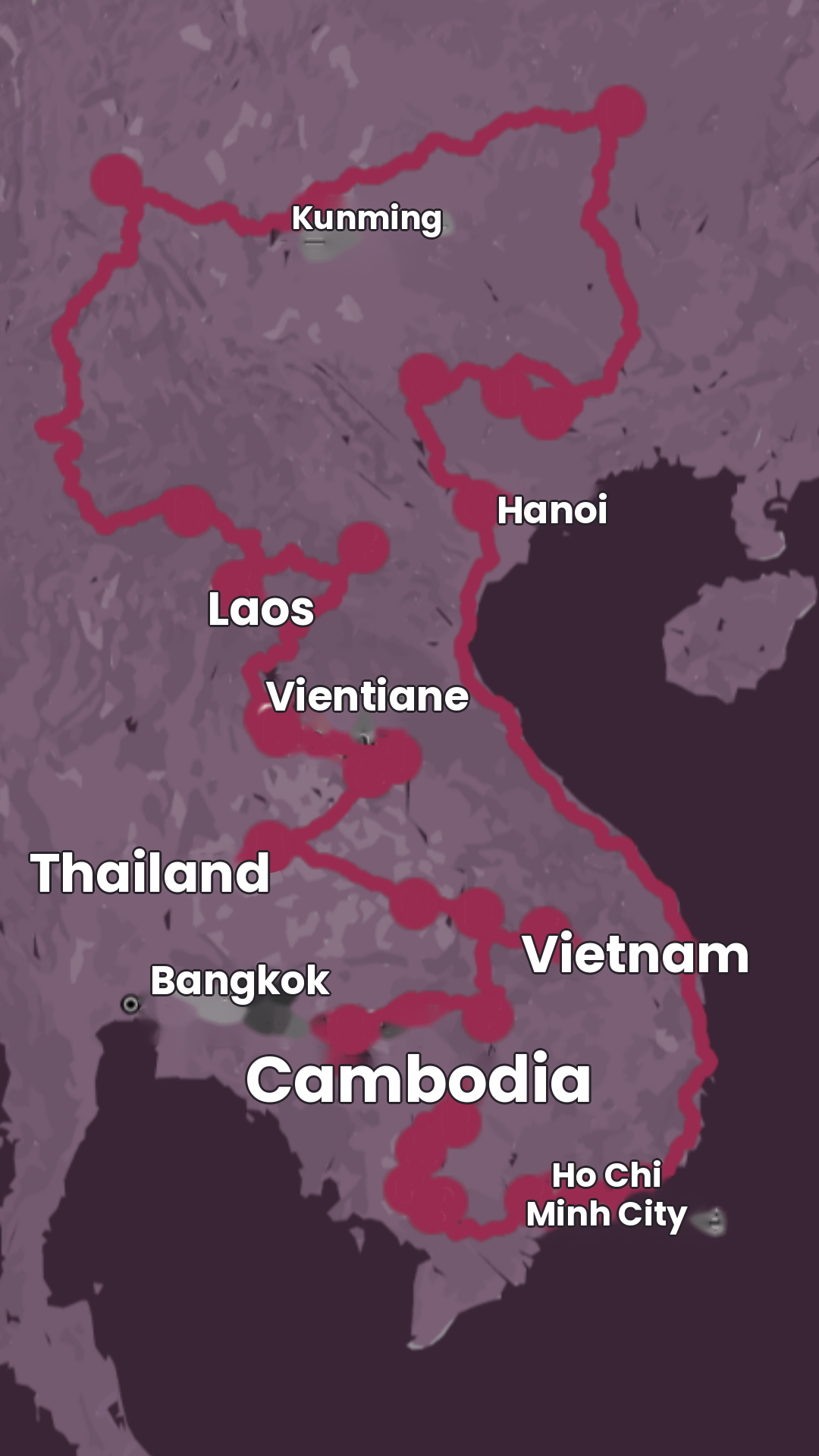
CAMBODIA THAILAND VIETNAM CHINA LAOSMy itinerary is fluid and will lead me to plenty of surprises, but here are the key stops along the way, and why each one matters.
⌘ Cambodia
Craft revival initiatives sit alongside communities where these techniques never stopped: from natural-dye silk ikats to the cotton krama and indigo dyes of Kampong Cham, the transitioning weaving economy of Takeo, and the wild silk, forest dyes, and rain-fed cotton of the Kuy indigenous communities in Stung Treng.
Highlights
- Lotus Farm: lotus fiber silk
- Institute for Khmer Textiles / Angkor Handicraft Association (Fair Trade Village): natural-dye silk ikats
- Kampong Cham: cotton krama, indigo dye
- Takeo province: transitioning weaving economy
- Phnom Srok District, Banteay Meanchey: women weavers
- Stung Treng Women's Development Centre (Kuy community): wild silk, forest dyes, rain-fed cotton.
⌘ China
The regions of Guizhou, Guangxi and Yunnan are well-known for preserving farm-to-fabric workflows built on organic hemp, wild cotton, native indigo, and centuries-old loom designs.
Highlights
- Guizhou: highest density of traditional handloom weavers and indigo dyers in China (Miao/Hmong, Dong, Buyi, Sui communities)
- Guangxi: bamboo-frame looms, natural fiber blends (Zhuang, Yao, Dong communities)
- Yunnan: Bai tie-dye in Zhoucheng, Dai brocade, Yi hemp and felting techniques
⌘ Vietnam
Traditional textile production in Vietnam is closely tied to ethnic minority heritage in the northern mountains, and to historic silk-weaving villages along the river deltas.
Highlights
- Tân Châu: black silk dyed with ebony berry
- Ha Nam province: raw silk reeling
- Phan Thi Thuan, near Hanoi: lotus silk pioneer
- Hoa Binh, Son La, Ninh Thuan provinces: brocade weaving
- H'Mong, Dao, and Lolo communities: raw hemp, stone-calendered indigo, beeswax batik, organic indigo fermentation outside factory supply chains.
⌘ Thailand
The Isan region in northeast Thailand is one of Southeast Asia's most resilient cultural and ecological regions, with closed-loop agriculture, natural fiber crafts, and sacred forest management born of necessity.
Highlights
- Sakon Nakhon: global capital of Pha Kram (indigo-dyed cotton)
- Inpaeng Network, Phu Phan Mountains: grassroots community forestry, agroforestry
- Ubon Ratchathani: mud-dyed cotton (Pha Choom Khow), Pha Choi supplementary-weft weaving If reachable: Chonnabot Silk District, the epicenter of Matmi (ikat) silk; Ban Phon — Phu Thai ethnic group
⌘ Laos
One of the most vibrant, uninterrupted hand-weaving traditions in Asia, built on home-grown mulberry silk, rain-fed organic cotton, and farm-to-vat botanical dyes.
Highlights
- Luang Namtha (north): Tai Lue indigo cotton weaving
- Luang Prabang: heritage raw silk weaving, natural dye research, mixed techniques
- Phuan ethnic silk: mythical, ethnic patterns
- Xam Neua (Sam Neua): ceremonial silk shawls and skirts
- Southern Laos: Katu & Ta-Oy ethnic bead-weaving (khung dệt lưng)
Carbon Footprint
This calculation covers transport, equipment, and digital communication directly linked to the project. It does not reflect my total personal annual carbon footprint, which would also include housing and baseline diet.
-
Bicycle: 0 tCO₂e (Zero usage emissions. Bicycle manufacturing footprint is minimal and amortized over several years of use.)
Trains: 0,02 to 0.09 tCO₂e
Ho Chi Minh City to Hanoi (Vietnam): 1,726 km (diesel line) -> ADEME factor ~40 gCO₂e/passenger-km ≈ 0.069 tCO₂e
Guangxi to Guizhou (Nanning-Guiyang HSR, China): 512 km (electric) ≈ 0.007 tCO₂e
Guizhou to Yunnan (Guiyang-Kunming HSR, China): 465 km (electric) ≈ 0.006 tCO₂e
Yunnan to Boten (Kunming-Laos Border HSR, China): 590 km (electric) ≈ 0.008 tCO₂e
Methodology for Chinese high-speed rail: Estimated power consumption (~0.023 kWh/passenger-km) × carbon intensity of the Chinese grid (560 gCO₂e/kWh, Ember 2024) ≈ 13 gCO₂e/passenger-km. Note: Yunnan relies heavily on hydropower, so real intensity is likely lower than the national average used here.
-
Tent, Homestay, or Guesthouse ≈ 0,80 kgCO₂e
For reference (repartition 1/3 each) :
1 night under a tent ≈ 0 kgCO₂e
1 night in a homestay ≈ 1 to 3 kgCO₂e
1 night in a simple guesthouse (without air conditioning) ≈ 5 to 10 kgCO₂e
-
Flexitarian Diet: ~0,96 tCO₂e
Mostly plant-based, accepting local meals offered or found along the route.
For reference, a flexitarian diet in Western Europe is estimated at 1.5 to 1.8 tCO₂e/year compared to ~2.4 tCO₂e/year for a standard meat-heavy diet (ADEME). This evaluation had been adapted to Asian diet’s impact (Poore & Nemecek)
-
Digital Hardware (Camera, Phone, Laptop, E-reader): ≈ 0.06 to 0.07 tCO₂e/year
Calculated by amortizing manufacturing emissions over equipment lifespans:
Laptop (156 kgCO₂e ÷ 4 years ≈ 39 kg/year);
Smartphone (32.8 kgCO₂e ÷ 3 years ≈ 11 kg/year);
Camera (estimated by analogy ≈ 10 kg/year);
E-reader (≈ 4 kg/year).
Textiles & Clothing: ≈ 0.04 tCO₂e Minimal wardrobe replacement over one year of travel (cotton t-shirt ≈ 7 kgCO₂e, technical trousers ≈ 20 kgCO₂e).
-
Website Traffic (Squarespace): ≈ 0.002 tCO₂e/year (2 kgCO₂e)
Calculated for approximately 1,000 views/year. At an average of 1.5 to 2.5 gCO₂e per view due to image-rich blog entries, 1,000 visits represent roughly 2 kg of CO₂e per year? so less than driving a car for 10 kilometers.
Social Media: ≈ 0.02 tCO₂e/year (30 minutes/day at 2.10 gCO₂e/minute across major social apps according to Greenspector 2021).
-
Initial On-Demand Print Run (~50 copies): ≈ 0.20 tCO₂e
Calculated at ~4 kgCO₂e per copy. Literature cites a range of 2.7 to 7.5 kgCO₂e per book depending on paper weight and ink coverage (Wells et al. 2012; Impakter 2025). The upper end of the scale is used here because this is a heavily illustrated photo book printed on coated paper in a small print run.
Initial Distribution (Independent Bookstores / Photo Festivals): Negligible (< 0.01 tCO₂e). Shipping around 50 copies (under 20 kg total) over short to medium distances remains an order of magnitude lower than production itself.
Print-on-Demand Future Sales: ≈ 4 kgCO₂e per copy sold Global print-on-demand platforms (Blurb, IngramSpark, Lulu) print near the buyer, drastically reducing international transport emissions compared to a centralized print run.
-
The total project-related operational footprint comes to approximately 2,10 to 2,17 tCO₂e (depending on if I take the train in Vietnam).
For comparison, the average annual carbon footprint of a French citizen is estimated at 8.2 tCO₂e/year (SDES/ADEME 2025).
-
ADEME: Base Empreinte / Base Carbone (Transport and hardware factors, 2018-2024)
SDES / French Ministry for Ecological Transition: Key Climate Figures 2025
Website Carbon Calculator (Wholegrain Digital): Sustainable Web Design Model v4
Greenspector: Environmental Footprint of Social Media Applications (2021)
Ember: Global Electricity Review 2025 (Chinese power grid carbon intensity)
Rail Distances: China Railway / Wikipedia (Nanning-Guiyang, Guiyang-Kunming, Kunming-Boten lines), Vietnam Railways (Hanoi to Ho Chi Minh City)
Wells, J-R. et al. (2012): Carbon Footprint Assessment of a Paperback Book, Journal of Industrial Ecology
Impakter (2025): How the Publishing Industry Addresses the Carbon Footprint of Books